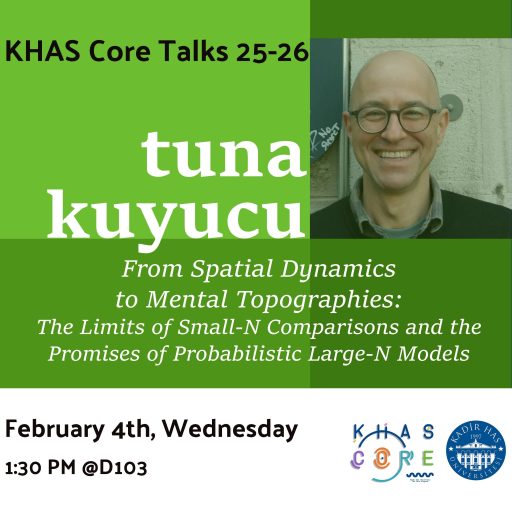
We cordially invite you to the upcoming talk by Associate Professor Tuna Kuyucu entitled “From Spatial Dynamics to Mental Topographies: The Limits of Small-N Comparisons and the Promises of Probabilistic Large-N Models.” The talk will take place on February, 4th at 1:30 PM. We would be very pleased if you could join us in classroom D103.
From Spatial Dynamics to Mental Topographies: The Limits of Small-N Comparisons and the Promises of Probabilistic Large-N Models
This presentation traces a decade-long methodological evolution from studying urban spatial dynamics through small-n comparisons to the quantitative mapping of individual “mental topographies.” Initially, my research focused on the political economy of urban regeneration (kentsel dönüşüm) in Turkey. Utilizing comparative historical methods, I investigated the institutional, legal, and societal dynamics driving the success or failure of projects across various Turkish cities. After ten years of urban research, my orientation shifted toward quantitative methods to analyze beliefs, attitudes, and values. This transition was driven by a growing dissatisfaction with the inherent limitations of small-n comparisons—specifically sampling bias, the overdetermination of outcomes, and a lack of generalizability. Seeking representative patterns and valid causal explanations, I moved toward probabilistic quantitative analyses.
Applying this lens, my recent work explores the multifaceted nature of nationalist and religious sentiments. Moving beyond limiting binaries like “ethnic vs. civic” or “religious vs. secular,” I employ Latent Class Analysis (LCA) to uncover heterogeneous “cultural models” shared en masse. In a study on nationalism (n=1,461), we utilized a resource distribution task to measure how distinct nationalist schemas drive preferential behavior toward in/out-group members. Our findings identify four distinct types of nationalism that significantly shape social action. My current research expands this scope, measuring religiosity and secularity among over 10,000 students across 53 Turkish universities. By applying LCA to this dataset, we aim to cluster distinct combinations of secular and religious beliefs to analyze how these types predict attitudes toward gender roles, immigration, and human rights.
Ultimately, this talk illustrates my commitment to bridging the gap between deep-seated sociological questions and cutting-edge analytical tools, providing a more nuanced and empirically rigorous understanding of Turkey’s complex socio-political landscape.
Tuna Kuyucu is an Associate Professor of Sociology at Boğaziçi University, Istanbul. He received his PhD in sociology from the University of Washington in 2009. His research areas include economic sociology, urban sociology, nationalism and, most recently, sociology of religion. Dr. Kuyucu’s has conducted extensive research on the political economy of urban regeneration and low-income housing in various Turkish cities, with a particular focus on the case of Istanbul. His work has been published in leading academic journals of the field of urban studies including Urban Studies, International Journal of Urban and Regional Research, Urban Affairs Review and Law&Society Review. Recently, Dr. Kuyucu began working on the structure of cultural values and beliefs in Turkey. His first project in this larger field has been on nationalist sentiments in Turkey, the findings of which has been published in Nations and Nationalism. His second project is a study of religiosity and secularity levels and types of university students in Turkey. Dr. Kuyucu has received several awards for his work including a prestigious fellowship from the Urban Studies Foundation, a competitive award from Kadir Has University as well as two teaching awards from Boğaziçi University.